 mada100
A machine controller can fail at the carrier-board level before software reaches the factory floor. Comparing system-on-module manufacturers involves more than matching processors. You are selecting a compute core, a supply chain, and an integration workload.
Vantron, founded in 2002, is an example of an industrial-grade embedded computing, Edge AI, and IIoT provider. Its portfolio includes system-on-modules, embedded boards, box PCs, panel PCs and gateways. For automation, ask how those capabilities fit your machine.
Start with the carrier-board boundary
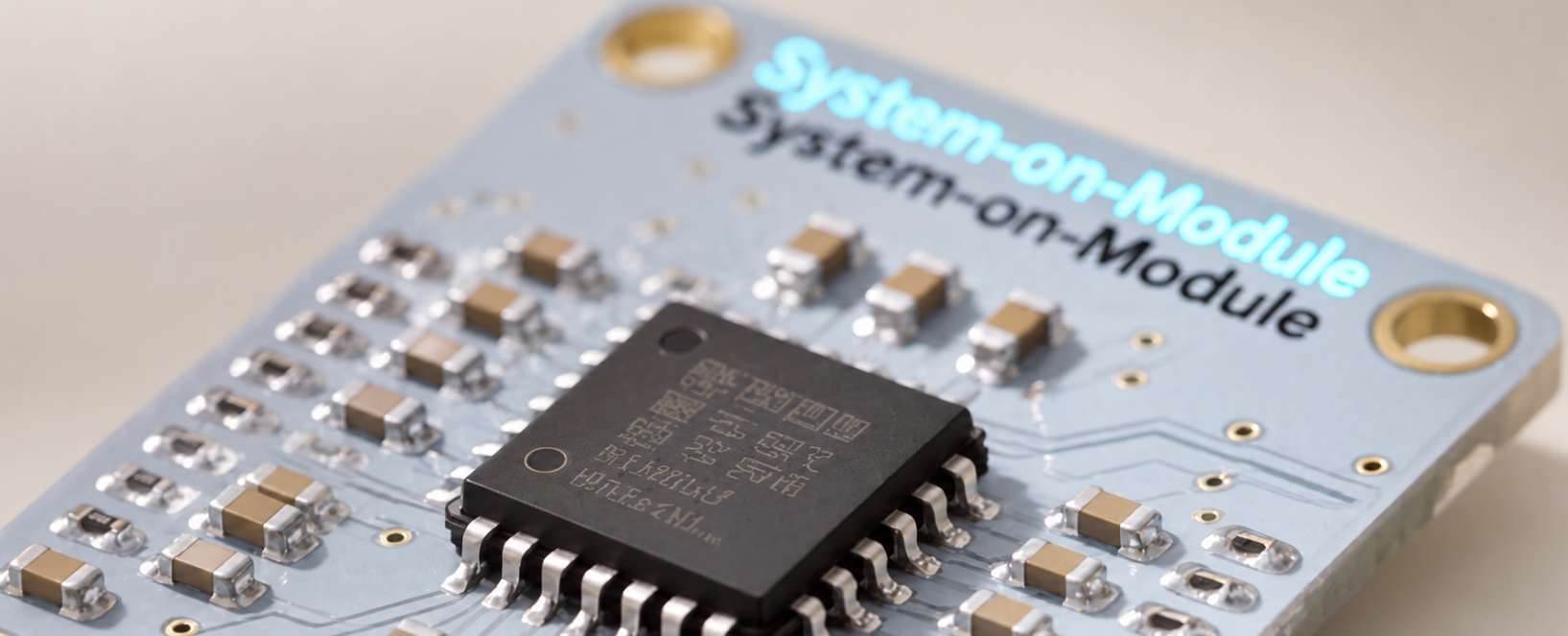
A System-on-Module, also called a computer on module or COM, places the processor, memory, and support circuitry on a replaceable board. Your carrier board adds power input, fieldbus connections, cameras, storage, display outputs, and service interfaces. At a warehouse pick station, you can test the compute core separately from the I/O board.
A standard module can reduce schematic work, but it does not remove carrier-board design, signal-integrity checks, boot validation, or thermal testing. Ask manufacturers for carrier-board files, board-support package scope, reference designs, and documentation for a stable build. Otherwise, a lower purchase cost can shift effort into your schedule.
SMARC, Qseven, COM Express, and OSM define interfaces, but a standard does not make every module interchangeable. Pin assignments, optional signals, power sequencing, and software support still vary. Compare the I/O required by your machine instead of choosing a standard by name.
Match the architecture to the automation workload
Processor choice should follow the control loop, vision load, and software environment. ARM modules often suit compact controllers running Linux or Android. x86 modules can ease porting when an application depends on existing libraries, industrial middleware, or legacy binaries. An ARM board will not run legacy x86 binaries without a porting cycle, so count that work before approval.
A packaging line with simple sensor aggregation may need predictable field I/O. An inspection station with several cameras may need local preprocessing, inference, and storage near each camera to reduce network traffic and response time. NXP i.MX8 / i.MX9, Qualcomm, MediaTek Genio, and Intel have different software and accelerator ecosystems; compare runtime support for your model, not just the platform label.
Edge AI changes the supplier question. If a controller identifies a damaged part beside a conveyor, local inference keeps decisions near the machine when cloud connectivity is delayed. You still need a model-update path, access controls, and fallback behavior when confidence is low. Ask who maintains drivers and inference runtimes across product life.
Can the software stack survive a machine redesign?
Treat an embedded computer module as a software dependency as much as a board. Confirm the kernel, bootloader, device-tree process, drivers, graphics stack, security updates, and debugging method. If a machine changes its camera, display, or CAN interface, you may need to rebuild the image and retest the boot path.
For a medical cart or fleet gateway, software continuity matters after installation. The supplier should explain how fixes are delivered, how versions are identified, and what happens when a component reaches end of life. BlueSphere remote management matters when remote monitoring or maintenance is planned. It adds service tools but does not replace local recovery procedures.
Separate code that depends on the operating system from code that talks to machine I/O. This can make a module change less disruptive, but it does not eliminate validation. A replacement compute core still needs testing with the actual sensors, displays, storage devices, and timing in your machine.
Measure integration risk, not just board price
A supplier review should cover mechanics, thermal behavior, and compliance. A fanless enclosure may remove moving parts, but a fanless design only stays silent within its stated thermal envelope. Check heat paths, mounting conditions, ambient exposure, and worst-case workload. A box PC beside a welding cell faces a different profile from a clean control cabinet.
Your automation computer may need Ethernet, serial ports, USB, CAN, isolated digital I/O, displays, or camera interfaces. Confirm whether each is native, routed through the carrier board, or dependent on external expansion. For a factory-floor HMI, check touch behavior, enclosure access, cable routing, and whether the front rating matches the cleaning process. An IP65 front bezel does not make rear connectors washdown-rated.
Certification planning belongs before the prototype freeze. Products designed to meet FCC, CE, and RoHS requirements can support a compliance plan, but the final machine may still require system-level testing. Experience across medical, transportation, and commercial applications can help identify evidence gaps. Treat that experience as planning support, not proof that every configuration carries the same certification.
Use lifecycle evidence to make the final choice
The final comparison is operational. Review product life, component-change procedures, documentation ownership, and escalation paths. A supplier supporting embedded computing since 2002 brings more than 20 years of product-lifecycle experience. Over 200 research personnel from a variety of fields can matter when your program needs parallel attention to board design, operating-system work, and field issues.
Choose a System-on-Module manufacturer when your team wants a reusable compute core and can own the carrier board, validation, and integration. Choose an embedded box PC or finished computer when a shorter hardware design cycle matters more than control over the internal architecture. In both cases, select the supplier that documents software, I/O, thermal, compliance, and lifecycle assumptions.
Before approval, run one representative workload through acceptance testing: boot, I/O, camera or sensor input, inference or control response, remote update, recovery, and power cycling. That evidence is more useful than a processor comparison alone. For an industrial embedded systems review, Vantron is one reference point; decide from the documented fit between the module and your machine.