 mada100
A telescopic boom lift can provide direct access to elevated equipment, structures, piping, and building systems when maintenance teams need substantial vertical height and horizontal reach. Power plants and industrial facilities also introduce complex operating conditions, including restricted work zones, uneven outdoor surfaces, overhead hazards, and nearby equipment. Selecting the machine therefore requires more than comparing maximum working height.
Match Reach to the Maintenance Task
Maintenance planning should begin by identifying the actual work position. A team may need to reach the upper section of a boiler structure, inspect elevated pipework, access lighting systems, or perform repairs around large industrial equipment. Maximum working height alone does not show whether the platform can reach the required location.
Horizontal outreach is equally important when the machine cannot be positioned directly below the work area. A telescopic configuration extends the platform outward in a relatively direct path, making reach calculations important when assessing tanks, buildings, conveyors, structural steel, or other fixed obstacles.
Evaluate the Working Environment
Power plants and industrial sites often contain multiple hazards within a relatively small footprint. Work-area planning should identify overhead electrical lines, cables, pipes, obstructions, slopes, unstable ground, traffic routes, and nearby operating equipment. OSHA recommends inspecting the work area before and during aerial-lift operation and avoiding conditions that exceed the equipment’s operating limits.
The surrounding atmosphere can also affect planning. Maintenance teams should consider whether the work area has dust, heat, moisture, chemicals, or other environmental conditions that require additional controls. Equipment should be selected and operated according to the manufacturer’s instructions and the site’s risk-assessment procedures.
Consider Load and Positioning Requirements
Platform capacity must include personnel, tools, and materials that will be carried during maintenance. Procurement teams should therefore estimate the normal working load rather than selecting equipment based solely on its advertised maximum capacity. The relationship between capacity, boom extension, and working position should also be reviewed through the manufacturer’s load chart.
Positioning requirements deserve equal attention. A machine may need enough space to approach the work area, turn, and establish a stable operating position. On industrial sites, this can be difficult when access roads are shared with service vehicles or surrounded by permanent structures.
Plan Around Outages and Maintenance Windows
Industrial maintenance is frequently scheduled around planned shutdowns or limited access windows. Equipment availability therefore becomes a logistical consideration as well as a technical one. Teams should confirm delivery timing, staging locations, fueling arrangements, operator requirements, inspection procedures, and removal plans before the maintenance period begins.
A well-defined equipment plan can also reduce interference with other contractors. When the work zone, travel route, and operating period are established in advance, maintenance teams can coordinate lifting activities with electrical, mechanical, insulation, inspection, and other site operations.
Check Safety Controls Before Mobilization
Aerial-lift planning should include operator training, pre-start inspection, work-zone controls, fall protection, and emergency procedures. OSHA guidance states that employers should ensure operators are trained and that work areas are inspected for hazards such as unstable surfaces, overhead obstructions, power lines, severe weather, and other nearby hazards.
Electrical hazards require particular attention around generating stations and industrial facilities. OSHA advises maintaining appropriate clearance from overhead power lines and treating them as energized unless properly de-energized and controlled. Equipment positioning should therefore be included in the site’s electrical safety planning rather than handled only after the machine arrives.
Where the ZT26J Fits Industrial Maintenance
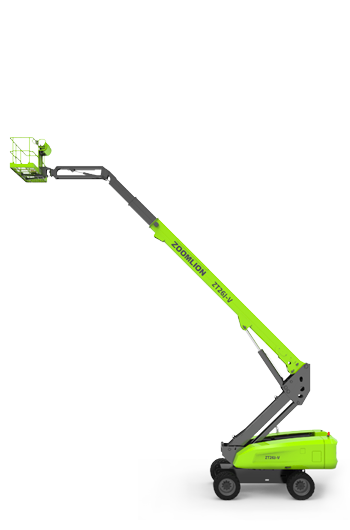
The ZT26J is a diesel telescopic boom lift designed for large-scale outdoor construction and industrial applications. According to the official product page, it provides a maximum working height of 28.7 m, platform height of 26.7 m, and horizontal outreach of 22.1 m. Its platform capacity is 300 kg unrestricted and 454 kg restricted, with a gross weight of 17,400 kg.
The ZT26J also has a 2.49 m stowed width, 11.91 m stowed length, and 2.82 m stowed height. Its specification lists 4WD, 45% gradeability, a 3.5 m inside turning radius, and a 6.1 m outside turning radius. These dimensions and performance figures are useful when reviewing access roads, plant layouts, staging areas, and work-zone positioning.
Key Specifications of the Zoomlion Telescopic Boom Lift
The Zoomlion telescopic boom lift ZT26J uses a Kubota V2607 Stage V or Kubota V3307 Stage III engine, with a 150 L fuel tank and 150 L hydraulic tank. The model uses solid tires as standard, with foam-filled tire options listed on the product page. A 360° continuous turntable swing and ±90° platform rotation support positioning flexibility at elevated work locations.
The machine also incorporates a parallel four-link lifting mechanism, hexagonal boom design, load-sensitive system, upgraded telematics, and a deadweight lowering system. Zoomlion Access states that the model is CE/ANSI/CSA certified. Buyers should still verify the certification and configuration required for their specific country, facility, and project.
Considering Zoomlion Access for Industrial Projects
Zoomlion Access currently offers more than 100 MEWPs across five categories, including scissor lifts, telescopic boom lifts, articulating boom lifts, spider lifts, and telehandlers. Their product information states that diesel telescopic boom models range from 20 m to 68 m working height, providing different equipment options for projects with varying reach requirements.
For buyers evaluating a Zoomlion telescopic boom lift, the ZT26J provides a defined combination of 28.7 m working height, 22.1 m horizontal outreach, 300/454 kg platform capacity, and 4WD mobility. Zoomlion Access also publishes product documentation and service-support information through their global platform, giving procurement teams additional information to review alongside site conditions and project requirements.