 mada100
Coherent communication increases the information carried by light by using both amplitude and phase. They create those complex symbols with separate in-phase and quadrature components, then recover them with a coherent receiver and digital processing.
This architecture improves spectral efficiency and reach, but it requires tighter control than straightforward on-off intensity transmission. The transmitter must preserve relationships among electrical waveforms, optical paths, bias points, and polarization states. Small imbalances can become constellation distortion, carrier leakage, or excess processing burden.
They therefore evaluate the modulator with the drivers, laser, control electronics, receiver, and algorithms that will form the commercial link rather than through a component bandwidth result alone.
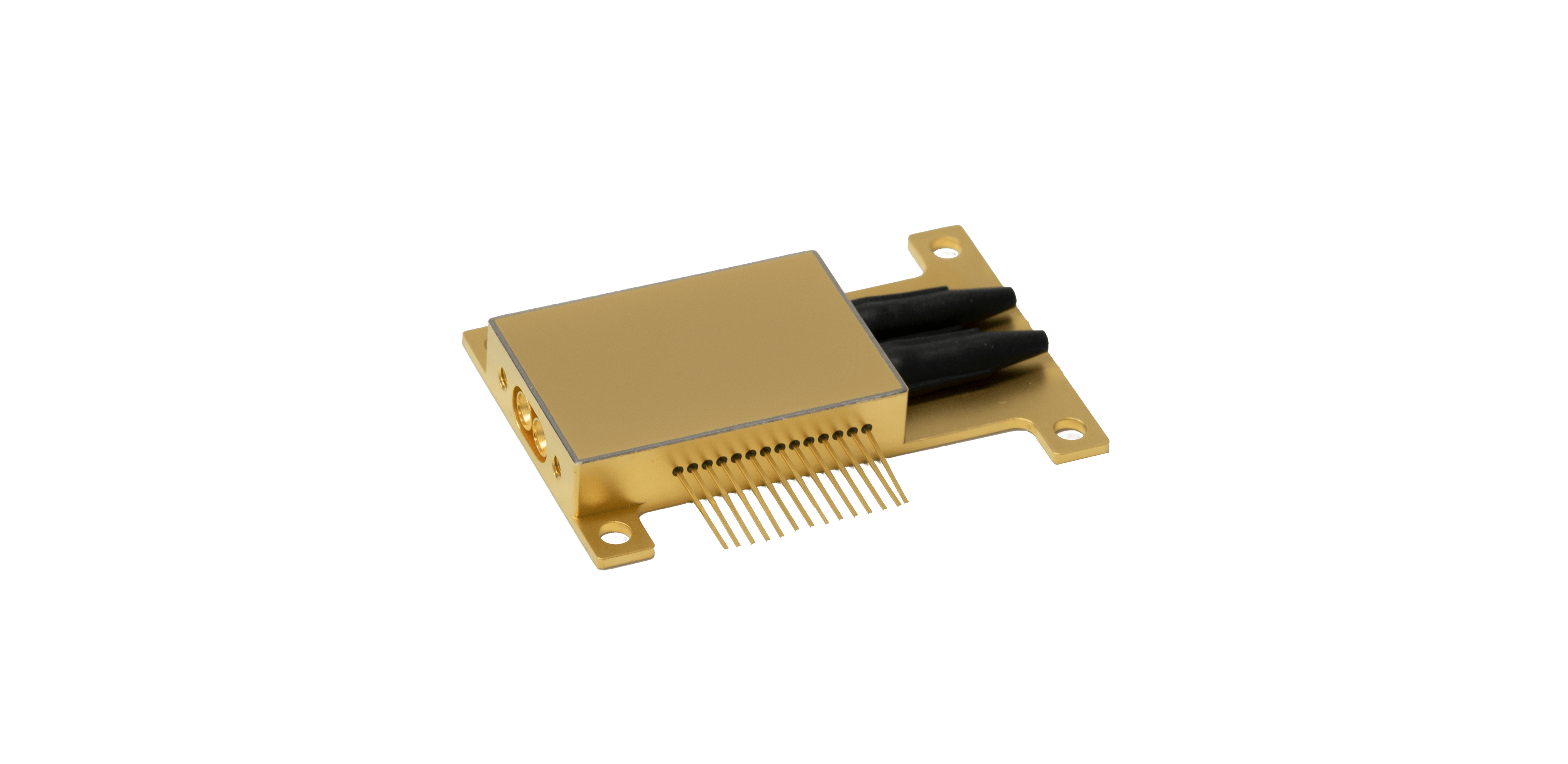
Current TFLN Devices include a 40 GHz IQ product with insertion loss below 6.5 dB, half-wave voltage below 3.5 V, and stated high stability. It is associated with formats such as QPSK and QAM. These figures guide architecture work, while link testing determines achievable error margin, reach, and tolerance to production variation.
In-Phase and Quadrature Paths Create Complex Optical Symbols
An IQ modulator typically contains nested interferometers. One branch produces the in-phase component, another produces the quadrature component, and a ninety-degree optical relationship combines them into a complex field.
By controlling the two electrical inputs, they can place symbols at selected amplitude and phase coordinates, supporting several coherent modulation formats. TFLN devices use electro-optic phase control to perform this mapping at high speed. The driver channels must provide matched timing, amplitude, and impedance, while the optical circuit must maintain appropriate splitting and phase relationships.
They budget skew and imbalance across the digital-to-analog converters, package, electrodes, and optical paths because compensation range in the processor is not unlimited. Format choice changes the required signal quality.
QPSK offers greater tolerance than higher-order QAM, while denser constellations carry more bits per symbol but place points closer together. They select modulation order by route, optical signal-to-noise ratio, fiber impairments, and operational margin. The same hardware may support several modes when control and calibration are sufficiently flexible.
Coherent Performance Depends on Balance, Bias, and Loss
Bandwidth of 40 GHz must be interpreted with the intended symbol rate, pulse shaping, and driver response. For an IQ modulator, amplitude ripple, phase response, and channel matching can affect error vector magnitude even before fiber transmission.
They request S-parameters or measured electro-optic response where available and confirm performance with representative modulated waveforms. A below-6.5-dB insertion-loss specification consumes part of the transmitter optical budget. When comparing TFLN devices, they include laser power, coupling, polarization combining, connector loss, and aging margin.
Increasing laser output to overcome loss may change relative-intensity noise, thermal load, or amplifier requirements, so optical power should be optimized across the full transmitter rather than assigned to one component. Bias stability determines whether the intended transfer functions and quadrature relationship remain centered.
Temperature and charge effects can move operating points, requiring monitoring and control. They characterize drift rate, control range, dither impact, and recovery after interruption. A stable component can reduce control effort, but the module still needs diagnostics that identify bias faults before traffic performance deteriorates.
Program Success Requires Joint Ownership Across the Transmitter Chain
Transmitter co-design assigns limits to the laser, driver, IQ modulator, package, and digital signal processor. They use simulations to explore how voltage, skew, loss, linearity, and noise combine, then validate them in hardware. TFLN devices should be represented by measured models rather than idealized reference blocks so that purchasing decisions reflect realistic margin and equalization demand.
Qualification includes constellation analysis, error vector magnitude, bit-error rate, optical spectrum, carrier suppression, and temperature behavior. Multiple units and lots reveal whether calibration values are stable enough for production.
They also test restart, firmware update, and alarm conditions because a coherent link must recover predictably after operational events, both perform under a carefully tuned laboratory setup. Commercial planning covers package capacity, control electronics, test equipment, and supplier responsibility for failures.
A technically capable die cannot compensate for an immature assembly or unclear interface. They establish change-review procedures and data exchange among component and module partners so that a shift in one stage can be traced before it affects network deployments. Digital processing should not become an unlimited repair mechanism.
Extra equalization or predistortion consumes power, latency, and implementation effort, and may reduce interoperability. They agree on a reasonable compensation budget, then require the optical and electrical hardware to remain inside the range that the production algorithm can manage reliably.
IQ modulation supports coherent systems by translating two electrical dimensions into a controllable optical field. Its value appears in the capacity, reach, and flexibility of the complete link, while its challenges appear in balance, bias, calibration, and multi-domain integration. They manage those challenges through shared budgets and representative measurements.
Before volume commitment, they build a transmitter reference unit and freeze its optical, electrical, thermal, and software conditions. Supplier samples are compared within that platform, and limits are derived from link margin rather than from arbitrary component targets.
The resulting evidence guides both sourcing and the control algorithms that sustain performance in operation. Constellation quality cannot be separated from driver matching, bias control, optical budget, and production calibration. A complete coherent transmitter using Liobate hardware gives the team the right context for evaluating waveform and operating behavior.