 mada100

Launching a custom decoration business requires more than finding an affordable printer. Entrepreneurs must balance equipment investment, material expenses, workspace requirements, and production capabilities before accepting their first orders. The UV DTF sticker printer price directly affects how much startup capital remains available for supplies, marketing, and daily operations. Understanding these cost relationships helps custom decorators choose equipment that fits their budgets without compromising their long-term business plans.
Understand What Determines Printer Pricing
UV DTF printers vary in price according to printing width, printhead configuration, automation, curing technology, and integrated finishing functions. Compact systems may suit small workshops producing personalized labels, while larger commercial machines can support more demanding workloads.
The purchase price should therefore be evaluated against the jobs a business expects to complete. A lower-cost machine may be suitable for testing demand, but limited capacity could become a constraint as orders increase. Conversely, purchasing a highly automated system before securing regular customers may tie up capital unnecessarily.
When comparing quotations, buyers should check which components are included, such as RIP software, laminating equipment, installation, and initial consumables. A transparent quotation makes it easier to compare complete setups rather than machine prices alone.
Budget for More Than the Initial Purchase
The printer is only one component of a startup budget. Custom decorators also need UV inks, AB transfer film, application tools, cleaning supplies, packaging materials, and suitable design software. Freight, import duties, operator training, and workspace preparation may add further expenses.
The UV DTF sticker printer price influences how much money remains for these essential items. Spending nearly the entire budget on equipment can leave a new business unable to maintain sufficient inventory or fulfill its first orders efficiently.
A practical budget separates expenses into three categories: one-time equipment and setup costs, recurring operating expenses, and a reserve for unexpected problems. This approach helps owners protect working capital while learning production procedures and building a customer base.
Match Machine Features to Commercial Requirements
Equipment specifications affect both the initial investment and the range of services a business can offer. Printing width determines how designs can be arranged on film, while printhead performance and curing systems influence production quality and workflow. Integrated laminating functions can also reduce the need for separate processing equipment.
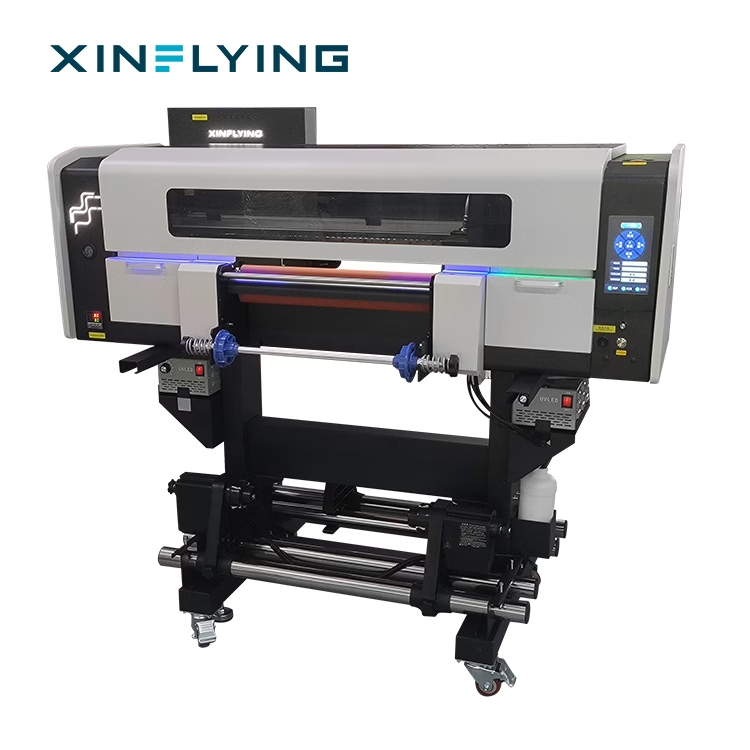
The Xinflying XF-420S i1600-U1 Printheads 3D Embroidery & UV DTF Integrated Printer combines UV DTF printing with simulated three-dimensional embroidery effects. Its listed printing width is 16.5 inches, or approximately 420 mm, and its nominal printing speed is 3.5 m²/h in eight-pass mode. Actual saleable output depends on job layout, finishing time, and operating conditions.
These specifications may interest businesses producing decorative transfers, labels, and customized merchandise. However, buyers should confirm the exact configuration in the quotation, since specifications can vary by model or version. They should also test representative materials and designs before committing to high-volume orders.
Calculate Operating Costs and Break-Even Requirements
A purchase becomes commercially worthwhile when the business generates enough contribution from completed orders to cover its costs. Each job should account for ink, film, labor, electricity, packaging, rejected prints, and other production expenses.
For example, a decorator producing customized labels should calculate material consumption per usable label rather than per printed sheet. Designs with substantial white ink coverage, complex artwork, or multiple finishing requirements may consume different amounts of material.
The UV DTF sticker printer price also affects the number of profitable orders needed to recover the equipment investment. A higher purchase cost requires greater cumulative contribution, unless improved capacity or product margins offset the difference.
A simple break-even calculation is:
Break-even order quantity = Initial investment ÷ Contribution per order
Contribution per order means revenue minus the variable costs directly associated with fulfilling that order. Fixed expenses, including rent and administrative costs, should also be included when calculating the business’s overall profitability.
Evaluate Supplier Support and Long-Term Value
An inexpensive machine may become costly if technical problems lead to frequent downtime, wasted film, or delayed deliveries. Supplier support therefore deserves consideration alongside the purchase quotation.
A reliable UV DTF printer manufacturer should provide clear technical specifications, maintenance instructions, compatible consumable recommendations, and information about warranty coverage and spare parts. Buyers should also ask how remote troubleshooting, operator training, and replacement components are handled.
Xinflying’s XF-420S offers an integrated printing and finishing configuration for businesses interested in combining decorative effects with UV DTF output. Its suitability depends on the buyer’s applications, required production volume, available budget, and preferred workflow.
Before placing an order, request a detailed quotation and confirm the included accessories, software, shipping arrangements, and after-sales services. Comparing these items helps reveal the practical cost of putting the machine into operation.
Choose an Investment That Supports Future Growth
Custom decorators should consider both current demand and realistic expansion plans. Businesses starting with small personalized orders may prioritize manageable costs and operational simplicity. Established workshops adding UV DTF services may place greater value on throughput, integrated functions, and the ability to handle a wider range of customer requirements.
A suitable UV DTF printer manufacturer can help buyers understand the differences between available configurations, but the final decision should be based on verified specifications and actual business needs.
Rather than selecting equipment solely because it has the lowest advertised price, buyers should compare total setup costs, expected utilization, material expenses, and support arrangements. This makes the investment easier to justify and reduces the risk of purchasing a machine that is either insufficient or unnecessarily expensive.
Build a Sustainable Budget Before Buying
The UV DTF sticker printer price is an important starting point, but it does not represent the full cost of launching a decoration business. Consumables, setup, maintenance, and working capital all influence whether the operation can fulfill orders consistently and achieve profitability.
For businesses evaluating Xinflying equipment, the XF-420S provides a specific option to assess for integrated UV DTF printing and simulated embroidery effects. Requesting a configuration-specific quotation, testing sample output, and calculating break-even requirements can help custom decorators make a more informed purchasing decision and establish a stronger foundation for sustainable growth.