 mada100
Food manufacturers comparing a food metal detector with X-ray inspection are not simply choosing between two machines. The real decision concerns which contaminants must be controlled, where inspection occurs, and how the product affects detection.
Metal detection remains effective for metallic foreign bodies, while X-ray systems can inspect a broader range of dense materials inside packaged or bulk products.
The Detection Principle Determines the Blind Spot
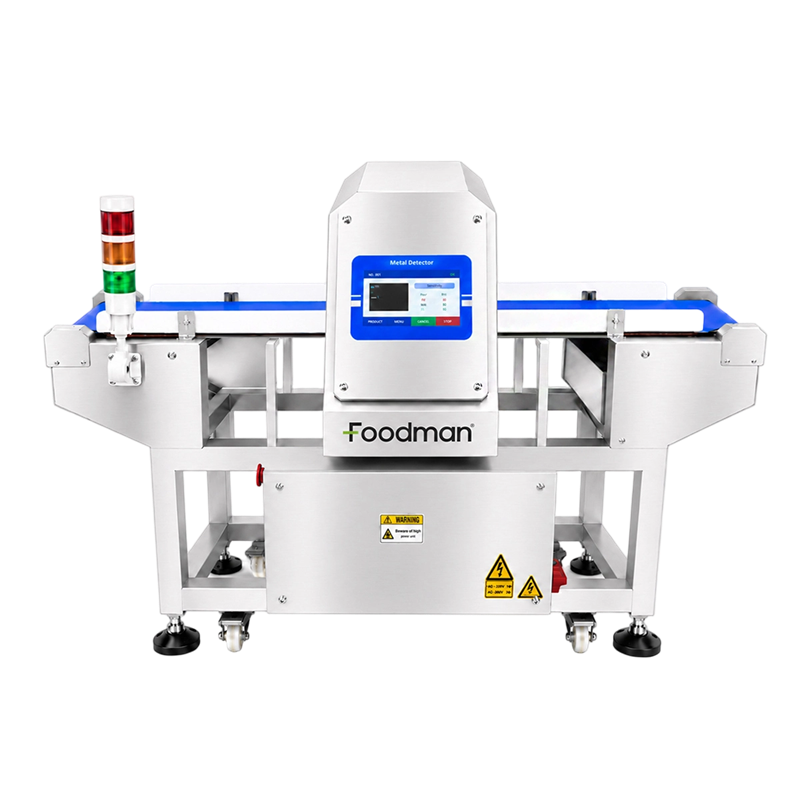
A food metal detector works through electromagnetic detection. Its sensing system responds to conductive metal passing through the inspection aperture, making the technology particularly suitable when the principal contamination risk involves ferrous, non-ferrous, or stainless-steel fragments. Foodman Vision lists these three metal categories among the contaminants its conveyor systems are designed to detect.
Product characteristics can influence the inspection signal. Moisture and salt, for example, may create product-effect signals in foods such as meat, cheese, and pickles. Aperture size, coil design, environmental interference, and operating conditions also affect sensitivity.
X-ray inspection uses a fundamentally different principle. X-rays penetrate the product and generate an image based on differences in material density. That means the system can evaluate internal structures rather than responding only to electromagnetic properties.
Where Metal Detection Stops
A food metal detector is highly relevant when metal fragments represent the dominant hazard and the production line requires straightforward, continuous screening. Conveyor configurations can be integrated into food-processing lines and are available for products ranging from packaged foods to meat, nuts, and other processed items.
Its principal limitation is material scope. Glass, stones, bones, ceramics, and many non-metallic foreign objects do not produce the same electromagnetic response as metal. Foodman Vision specifically identifies glass, stones, bone fragments, hard plastics, and rubber among contaminants that can fall outside conventional metal-detection capability.
That distinction becomes significant in meat, seafood, and packaged-food production. A processor concerned about residual bone, glass fragments, or dense foreign material may need an inspection technology that looks beyond conductivity.
Why X-Ray Changes the Inspection Scope
X-ray inspection broadens the detection task because material density becomes part of the analysis. Current Foodman Vision systems are described as detecting metals, glass, stones, bones, ceramics, rigid plastics, and other dense contaminants in packaged products.
The difference is particularly useful when contamination can originate from several sources. A packaged food line, for example, may face risks from metal equipment wear as well as glass, stone, bone, or hard plastic introduced during processing. X-ray inspection can address multiple categories during one inspection stage rather than focusing exclusively on metal.
Packaging also matters. X-ray systems can inspect products after packaging, allowing manufacturers to examine sealed goods without opening them. Foodman Vision offers systems for small sachets, medium-sized packages, large products, and bulk materials, demonstrating how inspection configurations can be matched to different production formats.
Match the Technology to the Product
Technology selection should start with the contamination profile rather than equipment popularity. A dry product with a clearly defined metal-contamination risk may be well suited to a food metal detector, particularly where simple metal screening meets the quality-control requirement.
Products with high moisture or salt content require closer evaluation because product effect can interfere with metal detection. Multi-frequency or dual-frequency approaches may help reduce such interference, according to Foodman Vision’s technical guidance.
Different priorities emerge for meat and seafood. Residual bone is a potential inspection target, while products may also contain metal from processing equipment. X-ray technology is therefore relevant where the objective extends beyond metallic contamination. Foodman Vision specifically describes X-ray applications for meat, poultry, seafood, and fish-bone inspection.
Choosing One System or Combining Both
The comparison does not always end with selecting a single technology. Some production environments benefit from layered inspection because each system addresses a different detection mechanism. Metal detection can provide focused screening for conductive contaminants, while X-ray inspection expands coverage to other dense foreign materials.
A combined strategy can be especially useful when contamination risks vary between processing stages. For example, metal detection may be positioned where metal fragments are the primary concern, followed by X-ray inspection after packaging when a broader foreign-object check is required.
Foodman approaches equipment selection from the perspective of the complete production process rather than treating inspection technology as an isolated purchase. The appropriate configuration depends on product characteristics, packaging, line layout, contamination risks, and the required inspection point.
Building the Right Inspection Point
The strongest choice between these technologies comes from defining what the inspection stage must actually detect. If the requirement is focused on ferrous, non-ferrous, and stainless-steel contaminants, a food metal detector can provide targeted protection. If the risk profile includes glass, stones, bones, ceramics, or dense plastics, X-ray inspection offers a broader detection scope.
Neither technology should be selected solely on equipment price or general detection claims. Production teams should evaluate the product, package, contamination sources, inspection location, throughput requirements, and rejection method together.
Testing representative products is also valuable because actual product characteristics can influence system performance.
Foodman Vision recognizes that inspection decisions are ultimately production-line decisions. The most suitable system is the one that closes the relevant contamination gap without creating unnecessary complexity.
For metal-focused risks, metal detection can be an efficient solution; for broader foreign-object control, X-ray inspection may provide substantially wider coverage. A properly defined risk profile makes the choice clearer and supports a more effective food-safety strategy.